
The warehouse management system that feeds the freight file
A forwarder’s warehouse is not a distribution center — it is the staging ground of consolidations. Cargo arrives, gets measured, becomes a receipt, and rolls into a shipment. That chain is the product.
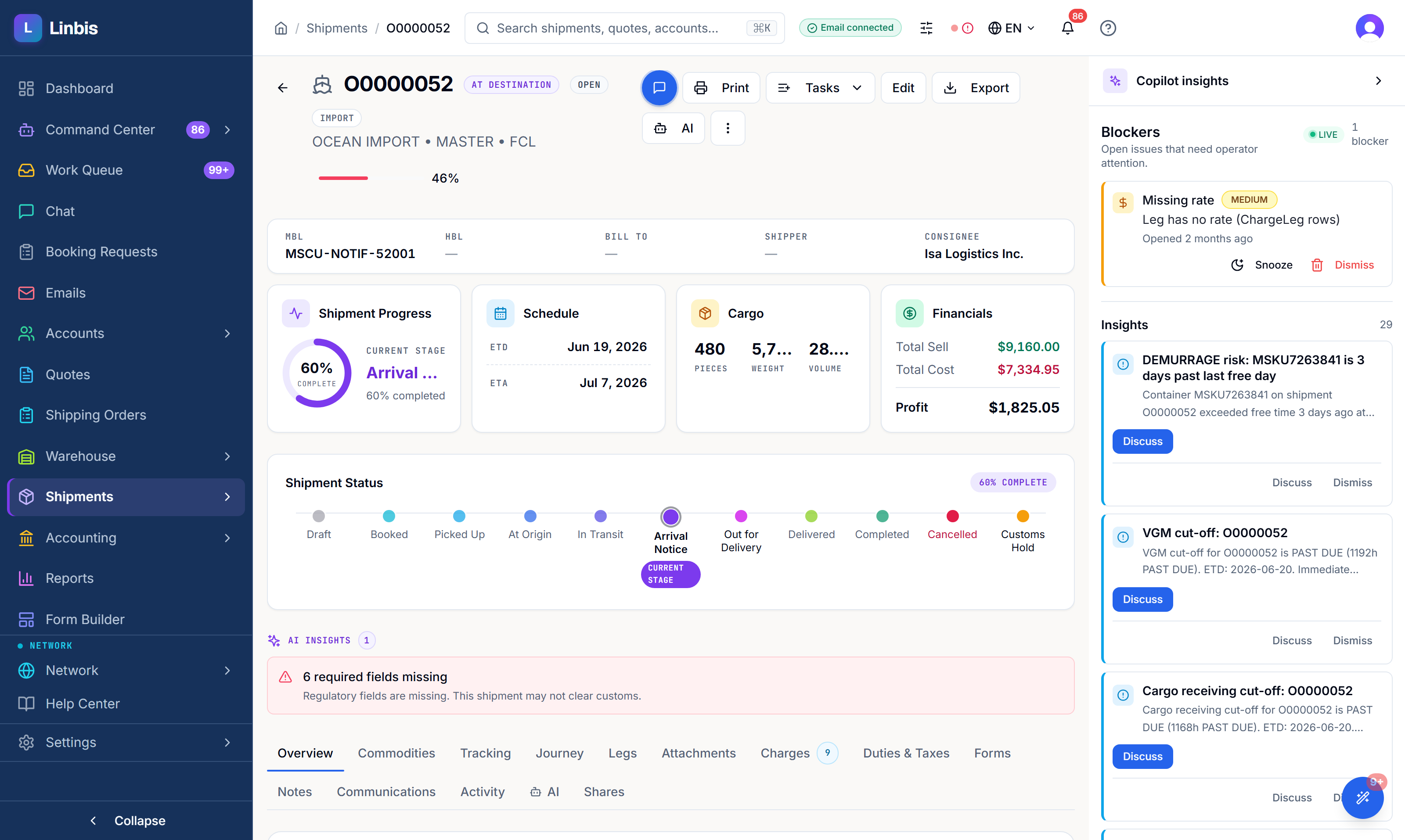
The short answer: A warehouse management system for freight forwarders runs the inbound-to-consolidation chain: expected arrivals, scan-driven receiving, dims captured with volume and chargeable weight computed, a warehouse receipt document the customer recognizes, cargo on hand with aging, and releases with proof of delivery — all connected to the freight files the cargo will ride on. Enterprise DC systems (slotting, waves, labor management) solve a different problem at a different price.
Forwarder-scale honesty: you probably don’t need a DC system
Search results for this category push enterprise distribution-center suites — slotting optimization, wave picking, labor management. A forwarder’s warehouse needs none of that and cannot pay for it. What it needs:
| Enterprise DC system | Forwarder warehouse |
|---|---|
| Slotting and wave optimization | Fast, accurate receiving — even when the Wi-Fi drops |
| Labor scheduling engines | Dims and weight captured once, chargeable weight computed |
| Store-level replenishment | A warehouse receipt the customer recognizes, emailed with the paperwork |
| Six-figure implementations | Cargo on hand with aging, releases with signature and photos |
Receive → measure → receipt → consolidate
- Expected arrival — the warehouse knows what is coming — receiving is checking, not discovering.
- Scan-driven receiving — expected, blind, quick, and bulk modes with piece-count enforcement and an undo; the barcode kiosk keeps working when the warehouse Wi-Fi does not.
- Dims to money — pieces, pallets, and containers nest to any depth with correct rollups; volume and chargeable weight are computed the moment dims are captured.
- The warehouse receipt — a real WR document from the file — and a configurable status flow that emails the customer with the paperwork attached as cargo moves.
- Into the consolidation — loose cargo builds into a container or master; the WR rolls into the freight file without re-typing. Unbuild works too.
- Release with proof — outbound with captured signature and photos — proof of delivery attached to the record forever.
Cargo on hand, and the storage math
The building answers its two daily questions instantly: what is here, and how long has it been here. Cargo on hand is a live register with aging — and storage time flows into charges on the file, so the days a pallet sits become billable lines instead of forgotten revenue. From there the charges travel the normal road: file, invoice, books.
Why the freight connection matters more than warehouse features
Any WMS can receive a box. The forwarder’s question is what happens next: the received cargo has to become a house shipment on a consolidation, its dims have to price the freight, and its paperwork has to reach the customer. Linbis is the system where the warehouse and the freight file are one platform — no integration project between the building and the business.
Frequently asked questions
What is a WMS for freight forwarders?
A warehouse system built around the forwarder’s chain: receive cargo, capture dims, compute volume and chargeable weight, issue a warehouse receipt, hold cargo on hand with aging, and consolidate into freight files — rather than DC features like slotting and wave picking.
Does receiving work without Wi-Fi?
Yes — the barcode scan kiosk keeps working when the warehouse Wi-Fi drops, and receiving supports expected, blind, quick, and bulk modes with piece-count enforcement and an undo.
What is a warehouse receipt (WR)?
The document that proves cargo entered your custody: pieces, dims, weights, condition, parties. In Linbis it is generated from the file, emailed with the paperwork by the status flow, and it rolls into the consolidation when the cargo ships.
Can it bill storage?
Yes — cargo on hand carries aging, and storage days become charge lines on the file that flow to the invoice like any other charge.
How does the warehouse connect to shipments?
Directly: build loose cargo into a container or master, and the warehouse receipt rolls into the freight file — same platform, no re-typing, profit visible on the file it feeds.
The warehouse that feeds the file
Receive it, measure it, receipt it, consolidate it — one platform from dock to bill of lading.
Start Free TrialThe screens and clips on this page are the real Linbis product recorded on a demonstration company; workflows shown are production features.