
Logistics software for freight forwarders and 3PLs
Generic logistics tools manage tasks. Forwarder logistics software manages files — consolidations, customs paperwork, free-time clocks, agent settlements. Here is the difference, and what Linbis actually covers.
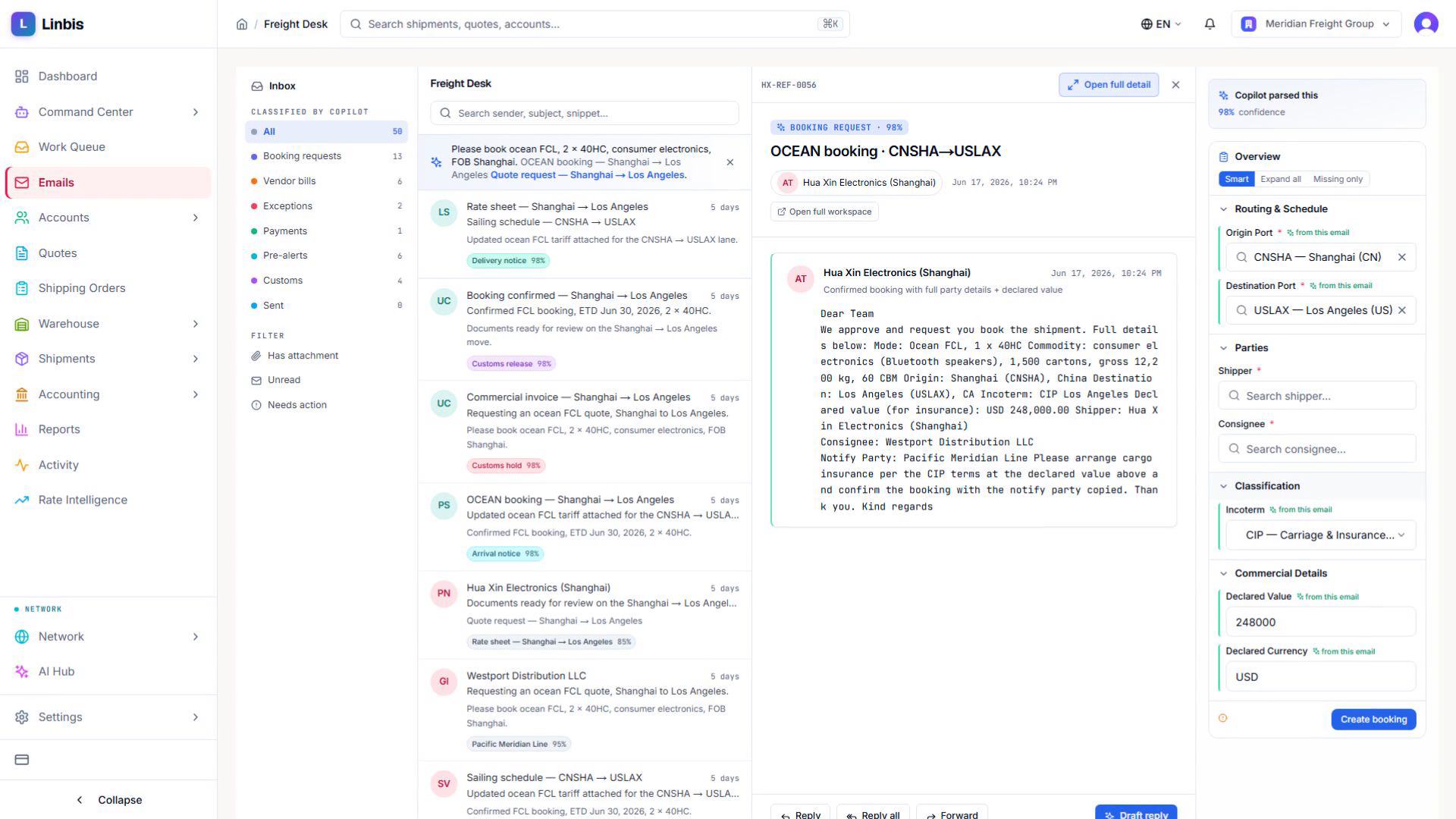
The short answer: Logistics software is a crowded term: project boards, delivery apps, and enterprise supply-chain suites all claim it. For a freight forwarder or 3PL, the test is specific: does it model houses under masters, generate the trade’s documents, run warehouse receipts, price against contract rates, and settle with overseas agents? Linbis is built for exactly that operator — used by consolidators, forwarders, NVOCCs, couriers, and 3PLs.
Forwarder logistics software vs generic logistics tools
A project-management tool with a "logistics template" can track tasks about a shipment. It cannot cut an HBL, run a demurrage clock, or net what your Shanghai agent owes you against what you owe them. The honest comparison:
| Question | Generic tool | Forwarder platform |
|---|---|---|
| Where does a booking email go? | A task, typed by hand | Read by AI into a structured booking, approved in one click |
| Who cuts the HBL? | Word template, re-typed | Generated from the file — one of more than 90 document templates, over 75 of which render live from the record |
| Who watches free time? | Someone’s calendar | Four cost clocks per container, flagged before the last free day |
| How is the agent settled? | Spreadsheet diplomacy | A per-shipment netting statement, debit and credit in one document |
| Where is the profit? | A quarterly surprise | On every file, computed from the charge lines |
What Linbis actually covers
One platform, one file model, these working parts — each with its own deep page:
| Module | What it does |
|---|---|
| Quotes | Priced against your rate cards, margin visible, public acceptance link, one-click conversion |
| Shipments | Air, ocean, ground, multimodal — houses under masters, stages that advance on real events |
| Warehouse | Receipts, cargo on hand, scan-driven receiving that works offline, releases with proof of delivery |
| Accounting | Freight GL, AR/AP, per-file P&L, agent statements, QuickBooks Online sync across 13 entity types (payments both ways) |
| AI | 24 email classifications (23 freight types plus unknown), extraction from attachments, drafted replies — human approval by default |
| CRM | Leads from cold email, opportunity board, customer portal with 13 screens in 8 languages |
The inbox is the operating system
Freight runs on email, so that is where the software has to live. Every message is read and classified the moment it arrives; the shipment, quote, or bill it describes is structured before you open it.
Watch: the AI freight inbox
Bookings, arrival notices, customs holds — sorted and structured on arrival, one approval away from becoming the record.
Video transcript
Every email is read and sorted the moment it lands — bookings, arrival notices, customs holds. Open one, and the shipment it describes is already structured — one approval turns it into the booking.
Built for working forwarders, priced like it
More than a thousand businesses have run on Linbis — consolidators, freight forwarders, forwarding agents, NVOCCs, couriers, and third-party logistics providers. The customer portal speaks eight languages, documents print in formats Latin American trade actually uses (including Spanish quotation layouts), and billing is multi-currency to the line level.
Pricing is public — $150 a month to start, free trial, no credit card — because comparing software should not require a sales call.
Frequently asked questions
What is logistics software?
Broadly, any software that manages the movement of goods. In practice the term covers three different species: generic task tools with logistics templates, shipper-side delivery management, and operator platforms for forwarders and 3PLs. Only the last one models consolidations, trade documents, and agent settlement.
Who is Linbis for?
Freight forwarders, consolidators, NVOCCs, forwarding agents, couriers, and 3PLs — companies that move other people’s cargo and live in the paperwork. Over a thousand businesses have used the platform.
Is it cloud-based?
Yes — Linbis is web-based SaaS. Nothing to install, and your team works from anywhere with the same live data.
Can my customers see their shipments?
Yes — a customer portal with real screens (bookings, quotes, documents, tracking, messaging), plus no-login branded tracking links per shipment. You control the milestone language they read.
How much does it cost?
Plans are public on the pricing page: $150/month including one user, $299/month including three, enterprise by conversation. Free trial with no credit card required.
Software that speaks freight
Files, not tasks. Documents, not templates. Profit you can see per shipment.
Start Free TrialThe screens and clips on this page are the real Linbis product recorded on a demonstration company; workflows shown are production features.